Defoe and Descartes’ beast-machine: a brief bibliography

HoundRecently, I became rather obsessed with two small pieces in Defoe’s Review of March 27th, 1705 and the ‘Supplement of January 1705’ (published after March). They debate the extent to which dogs can reason. Researching the contexts for this involved a deep dive into the complex history of the debate about reasoning animals, the animal soul, and Descartes’ ‘beast-machine’ as outlined in his Discourse on Method. The debate spun across religious, philosophical, classical, literary, journalistic and scientific writings for over a century after. But I particularly needed to map out the writings published in the years immediately before Defoe’s 1705 piece.[1] The results revealed a gratifying surge in the English debate from around 1690. Below I’ve listed these, in chronological order, with some very brief notes to indicate their position. In addition, Charles Morton – Defoe attended Morton’s Newington Green Dissenting Academy – clearly engaged in the debate in his own teaching, in a section entitled ‘Appendix of the Soules of Brutes’ in his MS dissertation ‘Pneumaticks: Or the Doctrine of Spirits’ (Morton is skeptical about the beast-machine).

T. Lucretius Carus the Epicurean philospher his six books De natura rerum done into English verse, with notes. Trans., Thomas Creech. Oxford: printed by L. Lichfield for Anthony Stephens, 1682. It had reached a fifth edition by 1700. (Creech’s notes acknowledge the possibility of animal rationality but not the logical consequence of the immortality of an animal soul).

Essays of Michael, Seigneur de Montaigne in Three Books. Trans., Charles Cotton. London, 1685. This had reached a third edition by 1700. (This is positive about animal rationality and willing to concede significant likenesses between human and animals).

Plutarch’s morals translated from the Greek by several hands. London: printed for T. Sawbridge, M. Gilliflower, R. Bently [and seven others], 1691; vol 5. Translations of the Moralia appeared from the 1680s, but only volume 5 included the two tales that debate animal rationality: ‘Which are more Crafty’ and ‘That Brute Beasts make use of Reason’. New editions in 1694 and 1704. (These two tales are sympathetic to animal reasoning).

John Ray, The wisdom of God manifested in the works of the creation being the substance of some common places delivered in the chappel of Trinity-College, in Cambridge. London: printed for Samuel Smith, 1691. Numerous expanded editions, including a fourth in 1704. (Strongly anti-Cartesian).

Gabriel Daniel, A voyage to the world of Cartesius written originally in French, and now translated into English. London: printed and sold by Thomas Bennet, 1692. (Satire on Cartesianism).

John Dunton, The Young-students-library containing extracts and abridgments of the most valuable books printed in England, and in the forreign journals, from the year sixty five, to this time … by the Athenian Society. London: printed for John Dunton, 1692. This contains That Beasts are meer Machines, divided into two Dissertations: At Amsterdam by J. Darmanson. (Anti-Cartesian).

Athenian Gazette, Feb 11, 1693. Reprinted in The Athenian oracle: being an entire collection of all the valuable questions and answers in the old Athenian mercuries. … By a member of the Athenian Society. London: printed for Andrew Bell, 1703-04. Vol. 1:504-507. (Goes over both sides of beast-machine debate).

Antoine Le Grande, An entire body of philosophy according to the principles of the famous Renate Des Cartes in three books, (I) the institution … (II) the history of nature … (III) a dissertation of the want of sense and knowledge in brute animals. Trans. Richard Blome. London, 1694. (Important dissemination of Descartes’s ideas in English).

‘The Turtle, or an Elegy, by Clarissa’, in, Gentleman’s Journal, or the Monthly Miscellany, III (August, 1694), 222.

Malebranch’s Search after truth. London: printed for J. Dunton, 1694-95. Trans. R. Sault. (Cartesian).[2]

John Norris, An essay towards the theory of the ideal or intelligible world.  Part II. London: printed for S. Manship and W. Hawes [1701]. Vol. 2, the chapter entitled ‘A Digression concerning the Souls of Brutes, whether they have any Thought or Sensation in them or no?’ (Certainly perceived as Cartesian, but allows for some doubt about the absolute difference between human and animals). [3]

William Coward, Second thoughts concerning human soul. London: printed for R. Basset, 1702. (Argues that body and soul are one entity and so for the parity of human and animal soul).[4]

John Toland, Letters to Serena. London: printed for Bernard Lintot [1704]. (Mechanistic debate about motion that implies similarity between animal and human matter).

_________________________________

The image is a detail from ‘The Refreshment’, 1818. Courtesy Mills Library, McMaster University, and from the files of the McMaster journal Eighteenth-Century Fiction. http://eighteenthcenturyfiction.tumblr.com/

[1] I was aided by Erica Fudge’s Brutal Reasoning. Animals, Rationality, and Humanity in Early Modern England. Ithaca and London: Cornell University Press, 2006, Keith Thomas’s magisterial Man and the Natural World, 1500-1800 (1983), and Wallace Shugg’s earlier ‘The Cartesian Beast-Machine in English Literature (1663-1750)’ (Journal of the History of Ideas, 29: 2 (1968)). I was able to refine some of this research and find additional material via searches on ECCO, EEBO and the ESTC.

[2] Clearly, Dunton was deeply interested in disseminating all sides of the animal-machine debate coming from continental Europe.

[3] John Locke, letter, 21 March 1703-4. The Works of John Locke in Nine Volumes, (London: Rivington, 1824 12th ed.). Vol. 9. http://oll.libertyfund.org/index.php?option=com_staticxt&staticfile=show.php%3Ftitle=1726&layout=html

“Men of Mr. Norris’s way seem to me to decree, rather than to argue. They, against all evidence of sense and reason, decree brutes to be machines, only because their hypothesis requires it; and then with a like authority, suppose, as you rightly observe, what they should prove: viz. that whatsoever thinks, is immaterial.”

[4] Norris and Coward are particularly interesting because they are name-checked in Defoe’s The Consolidator: Or, Memoirs of Sundry Transactions From the World in the Moon, also published in 1705.
Mapping books, mapping a library

When I’m not working or blogging on Defoe, I’m working on Bishop Richard Hurd, the clergyman and literary scholar (1720-1808). Currently I’ve being paying attention to his library. Built in the 1780s, Hurd’s library – both the book collection and the physical library itself – still exists at the old Bishopric palace of Hartlebury Castle. I’m not going to go into detail here, but suffice to say, it’s a wonder (check their website for more details).

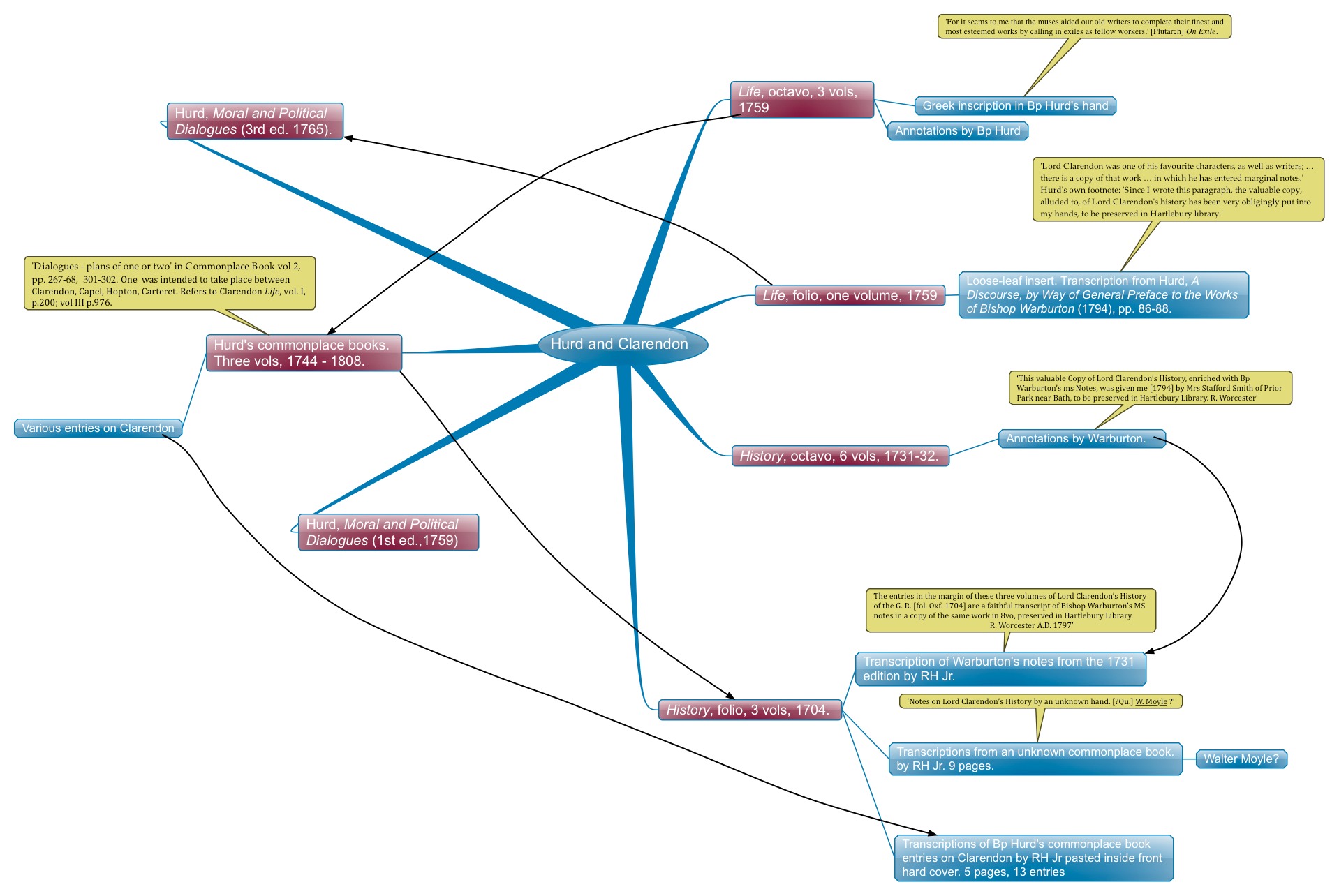
Now I knew from previous visits that the collection contained ms correspondence, Hurd’s commonplace books, printed books he has annotated himself, works annotated by previous owners, as well as various material and written interventions by Richard Hurd Jr. (Hurd’s nephew, secretary, and erstwhile librarian). What I wanted to do is to try to get a sense of how such books and their annotations might relate to each other and how they relate to Hurd’s published output. Now the library has over 3,000 titles, of which quite a number are annotated, so I wanted to track such interactions with a case study of the relations between Hurd’s publication, Moral and Political Dialogues (1759), and the various works by Edward Hyde, Earl of Clarendon held in various editions in his library. But tracking – mapping – the complex relations between these books, their owners, and the annotations became almost impossible in traditional prose description; particularly as the annotations and the interactions were also time-sensitive. What I needed was a visual aid.

At about the same I came across the project Six Degrees of Francis Bacon (an inspired title for a project!) The striking way in which the project visually presented data to track a network of literary relationships was an inspiration. I didn’t have such resources at hand, so I opted for a quick and dirty option and tried out some free mind-mapping software. What I produced – for a paper for the Writers and their libraries conference – rendered rather nicely a set of relations between objects and annotations.

Clarendon in Hurd's Library
[Click to enlarge]
It’s quite striking. But I found that the mind-mapping tools I tried all depended upon a single (or a very limited number) of starting points from which sub-topics were then hierarchically related. As you can see, I ended up by having to put the rather vague and abstract phrase ‘Hurd and Clarendon’ as the epicentre of this series of interactions. Now I had a number of objects in my case study, none of which could be said to the origin of a subsequent series of relations. In fact that was the very problem I was trying to articulate: how can one envisage a variety of interactions between objects, the contexts of which are separated by time, but which came to occupy the same physical and chronological space?

Subsequently, I’ve started experimenting with a piece of software not out of beta yet but which looks fantastic and, more to the point, very easy to use. This is Scapple, designed by the producers of Scrivenor. Details at the literatureandlatte forum.

[Click to enlarge]
[Click to enlarge]

What striking is that because Scapple is designed to mimic the rather looser way people actually doodle ideas, it doesn’t require a single starting-point. For a project like mine where I needed to map interactions between objects that have more complex and non-hierarchical relationships, this was ideal. Although I haven’t yet played around with the aesthetic appearance, the tentative reconstruction I’ve begun already looks very different without a centre. At the moment I don’t know if this will ever get beyond a personal tool, but even if that’s all it does, it should enable me to better conceive and represent the idea I began with: a kind of dialogue or virtual conversation between authors and their annotations within a library.

A party in Pall Mall: location, location, location

While teaching Defoe’s Roxana to my students, I was sent an intriguing book entitled A Curious Invitation: The Forty Greatest Parties in Literature by Suzette Field. Now I’m not qualified to talk about all the works discussed here: from the Book of Daniel through Proust to Hollinghurst there is surprising variety of balls, routs, revels, masques, orgies, feasts, banquets, proms, weddings, birthdays and even a wake (Finnegan’s, of course). But I am able to comment on what Field calls ‘A Little Ball at Roxana’s House’. In common with all the parties, each entry has sections entitled ‘The Hostess’, ‘The Invitation’, ‘The Venue’, ‘The Guest List’, The Food and Drink’, ‘The Dress Code’, ‘The Entertainment’, ‘The Outcome’, and ‘The Legacy’. It all works rather neatly for Roxana’s ball at which she appears in her Oriental masquerade (also, Field has obviously done her research: she even notes ‘there is no definitive evidence that Defoe wrote Roxana’). However, my eye was caught by Field’s description of the party’s location in Roxana’s ‘handsome apartments in Pall Mall’.[1]

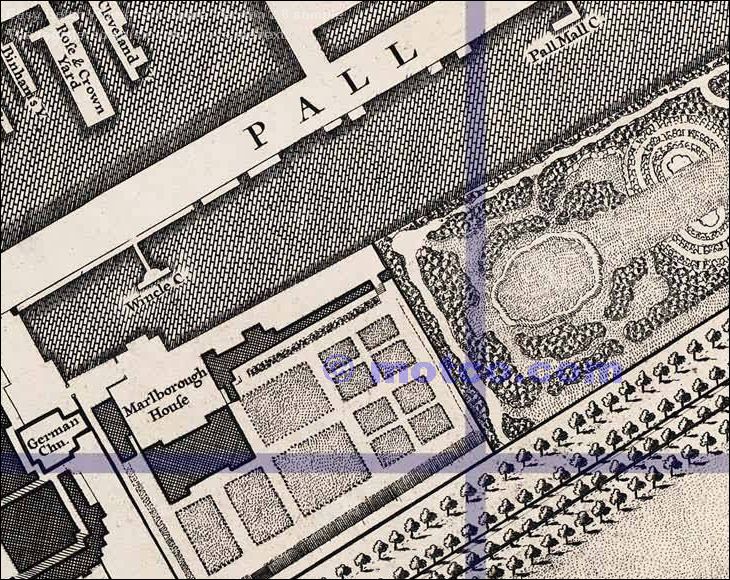
Pall Mall, Rocque, 1746, via Old Bailey Online, courtesy Motco Enterprises Limited Ref: www.motco.com

Described by Edward Hatten as a ‘fine spacious’ street, Pall Mall’s grandeur reflected the lives of its wealthy, if transient, population of visiting dignitaries and pleasure-seekers.[2] John Macky described Pall Mall as ‘the ordinary residence of all Strangers’ because of its proximity to the ‘Palace, the Park, the Parliament-House, the Theatres, and the Chocolate and Coffee-Houses, where the best company frequents.’ In fact Macky painted the life in the Pall Mall area as one continual party, at least for men:

We rise at Nine, and those that frequent great Mens Levees find Entertainment at them until Eleven … about Twelve the Beau Monde assembles in several Coffee or Chocolate-Houses … If it is fine Weather we take a turn in the Park until about Two, when we go into Dinner, and if it be dirty you are entertained at Picket or Basset at White’s, or you may talk Politicks at Smyrna or St. James’s.

After dinner there was the theatre (Haymarket theatre was at the end of Pall Mall); and after that,

the best Company generally go to Tom’s and Will’s Coffee-Houses, near adjoining, where there is playing at Picket and the best of Conversation until Midnight. Here you will see Blue and Green Ribbons and Stars, sitting familiarly … Or if you like rather the Company of Ladies, there are Assemblies at most People of Qualities Houses.[3]

Clearly, Macky was fascinated by the pleasures of the area and the status of its denizens.

It’s a key context to Defoe’s Roxana, whose apartment in fashionable Pall Mall reflects her wish to appear as a ‘soi-disant wealthy widow’, as Field nicely puts it. Yet as she rightly points out, in one regard Roxana’s choice of location is not entirely well calculated: despite Macky’s excitement at the wealth on display in Pall Mall, the residents of the West end of London are also those who ‘tended to live beyond their means’. As Roxana declares, she finds herself harassed by ‘Fortune-Hunters and Bites … to make a Prey of me and my Money … Lovers, Beaus, and Fops of Quality’ (1724, p.210). Field picks up on Roxana’s fascination with status, noting, in the section entitled ‘The Invitation’, that ‘[n]evertheless she is not averse to a bit of social advancement’. Now this is either an ironic understatement more suitable to an Austen novel, or a fudging of Defoe’s intent to underline Roxana’s crucial weakness: ‘I aim’d at other things, and was possess’d with so vain an Opinion of my own Beauty, that nothing less than the KING himself was in my Eye’ (1724, p.210).

However, the voice in Field’s book is frequently that of the understated party hostess that does not obtrude upon or overly manage her guests. For example, in common with all the entries in the book, the next section is called ‘The Venue’. Here Field quotes Roxana’s description that her apartment was in a house ‘out of which was a private Door into the King’s Garden’ (1724, p.200). Defoe places Roxana’s comment some time before her comment on catching the King’s eye, separated as they are by the discussion of Roxana’s financial dealings with Sir Robert Clayton. Presumably Defoe intended for us to remember the significant topography of her apartment when he has Roxana admit her vanity. Coming immediately after her comment on social advancement, Field manages to infer just as much as Defoe intended about Roxana’s social vanity and her choice of location. In ‘The Outcome’, she comments, in another understatement, that ‘Roxana has succeeded in catching the royal eye’, footonoting that ‘It is perhaps no coincidence that Roxana resides on Pall Mall, as did the King’s most famous mistress, Nell Gwynne.’ Location, location, location: Defoe’s interleaving of sexuality, historical allusion and moral topography is clear in Roxana’s party.


[1] Suzette Field, A Curious Invitation: The Forty Greatest Parties in Literature (London, Picador: 2012), pp.33-38.

[2] Edward Hatton, A New View of London. London, 1708, p.61.

[3] John Macky, A Journey Through England. London, 1714, pp. 107-109. Macky later breathlessly lists the members of the aristocracy living on Pall Mall and the streets around, p. 128.

Defoe at the 2013 BSECS annual meeting

The theme for the 42nd annual meeting of the British Society for Eighteenth-Century Studies was ‘Credit, Money, and the Market’. Defoe, I thought, is going to be big at this conference.

Sadly, I had to miss Robert D. Hume’s  keynote lecture: from what I heard from others and from talking with Robert later, Defoe’s novels featured quite significantly. To an extent, I’d got the gist of this particular argument a couple of years ago from one of his postgraduate students at Penn State, David W. Spielman (those who attended the Defoe Society’s inaugural conference in Tulsa 2009 may remember David’s paper). Essentially, in calculating modern monetary equivalents, we’ve all being grossly underestimating the multiplier.[1] For Defoe’s novels such as Robinson Crusoe, Moll Flanders, and Roxana – in which the protagonists practically drool over their lists of wealth and goods – this is very important. Take Roxana’s estimate of her own and her Dutch husband’s final combined wealth: £100,000. Given that only 200 families in England, or 0.01% of the population, had more than £6,000 this astonishing figure places them at the very top of the English rich list. The modern equivalent, according to Hume and Spielman’s calculation, is between £20 – £30 million. As they have argued, such a remarkable figure asks us to seriously reconsider these novels’ supposed realism. More importantly I think, is the element of fantasy: this is wealth porn (and I always thank David Fairer for pointing out to me some time ago that Defoe’s lists of money and goods seem almost erotically charged).

Immediately following that was my own paper, ‘Swallows and Hounds: Defoe’s Thinking Animals’, so I can’t really report on that other than to say that you can get a partial sense of it by reading on this blog an earlier post entitled ‘Our Summer Friends the Swallows’.

On the Friday I chaired the Defoe Society-sponsored panel entitled ‘Defoe, speculation, and moral hazards’. Frauke Jung (Worcester) spoke on ‘Speculation, News, and Nation: Defoe’s Anatomy of Exchange Alley (1719). Jung’s close reading of Defoe’s pamphlet sought to underline the inextricability of those three terms. The images of what she called ‘malignant growth [and] uncontrolled speculation’ clearly relates to the pamphlet’s state-of-the-nation style. But Jung also emphasised the notion of speculation as bound to news and finance –‘analogous systems’ – as revealed in Defoe’s image of a doorway exchange of furtive stock-price gossip in the alley. Indeed, Jung’s discussion of Defoe’s minute topography of Exchange Alley, “the whole Stock-jobbing Globe” as he puts it, reveals his clever analysis of an ecology of speculative contagion undermining a more natural body-politic.

Jeanne Clegg (University of Venice), in her paper, ‘The market in stolen goods in Moll Flanders, Colonel Jack and Jonathan Wild,’ discussed Defoe’s analysis of the methods by which stolen goods are converted into ‘hard cash’. In Moll Flanders, our heroine has a ‘privileged’ relationship with her own fence – Moll’s old governess turned pawnbroker in the sense that Moll receives preferential rates and benefits from her fence’s very smoothly organized network. In Colonel Jack, Defoe reverses this picture by representing the gang’s receivers as corrupt and untrustworthy. Clegg then looked to Jonathan Wild, arguing that in this novel we see a picture of a receiver who is organized, professional and who has well developed systems, networks and markets. Intriguingly, Clegg measured this against evidence from Old Bailey Online, tracking criminals arrested for receiving and /or theft. Clegg notes that out of 18 trials (in the period of the early eighteenth century) only one criminal had a regular fence: the rest relied on a opportunistic method of choosing receivers which even included genuine pawnbrokers and shopkeepers (which goes far in explaining their lack of success!) Clegg’s argument was that Defoe emphasized the professional and systemized networks of fencing, rather than these haphazard practices, and so contributed to the myth of the organized criminal underground. However, her reliance on the evidence of Jonathan Wild – a work whose attribution to Defoe is now under question – potentially problematizes this as a reflection of Defoe’s particular vision.

The final paper of the panel, by Chris Borsing (Trinity College, Dublin), intriguingly paralleled Captain Singleton’s narrative contract with the reader with its narrative of economic transformation, in his paper ‘Daniel Defoe Names the Price; or, Captain Singleton (1720) Bargains with its Customers’. He wittily argued that this novel offers readers ‘voyeuristic pleasures’ of ‘money regeneration and spiritual laundering’. Bob Singleton and Williams Walters’ transformation from plundering pirates to wealthy citizens at the end of the novel is accompanied by and dependent upon a contract with the reader and their ‘willing collusion’ in their secrecy within British society. Moreover, Borsing’s summary – ‘buyer beware!’ – seemed to suggest that such a contract actually reveals more than it conceals: economic and narrative laundering are inextricable in this novel.

One paper that I was glad to have heard was during a panel organised by Sacha Klement (Exeter) entitled ‘Transgressive Enlightenment?’ After two excellent papers on the desert caravan route, Majid Alavi (Islamic Azad University of Tabriz) in his paper, ‘Similar Landscapes, Different Minds’, revisited the relationship between Robinson Crusoe and Ibn Tofayl’s Hayy Ibn Yaqzãn, the philosophical fiction written in twelfth-century Islamic Spain and regarded by some as one of the influences upon Defoe’s novel. Tofayl’s narrative was translated into English in the late seventeenth and early eighteenth centuries (an edition of Hayy Ibn Yaqzãn appeared in 1713). Surprisingly, it was the third most translated text after the Koran and Arabian Nights, and Locke, Spinoza and Leibnitz pressed for the propagation of Hayy Ibn Yaqzãn. Asking whether Defoe was following Tofayl or whether they were both addressing ‘global archetypes’, Alavi at first underlines the resemblance that despite isolation both Crusoe and Hayy evolved systems of philosophy and experienced spiritual enlightenment. However, Alavi convincingly argued that, by contrast, Hayy’s isolation ‘taught him endless tolerance’ and that Hayy returns to island to avoid the corruption of society and in order to better ‘serve god’. Clearly this is a very different outcome to the first two parts of Robinson Crusoe, although I wondered whether a consideration of the third part of the trilogy, The Serious Reflections During the Life and Surprizing Adventures of Robinson Crusoe, might have added to this interesting discussion.

Due to an almost inevitable clash between panels, I was unable to see Nicholas Seager’s paper ‘“She will not be the Tyrant they desire”: Defoe on Queen Anne’, but I did catch the final two papers of the conference devoted to Defoe which were part of a panel chaired by Nick: ‘Defoe, Credit and Economic Imperialism’. Michael Genovese (University of Kentucky) presented us, in ‘Bankruptcy and Plague: Credit and Contagion in Defoe’, with the powerful proposition that Defoe’s economic theory suggested a ‘proto-sentimental’ alignment of ‘sympathy and commerce’. A 1707 Review piece established a distinction between the ‘knavish debtor’ and the sentimental victims of misfortune pictured as the ‘sons and daughters of sorrow.’ But strikingly, Defoe also included creditors as objects of sympathy; bound in a contagious chain of mutual ‘entanglement’, one ruin leads to another. Defoe, Genovese argues, suggests that it is only at such times that ‘society’ is revealed: ‘social integration’ paradoxically relies upon the feeling that financial ruin ‘lies just around the corner for everyone.’ In the second paper of the panel Captain Singleton once again came in for attention. Tsai-ching Yeh’s argument (Huafan University), in  ‘Piracy and Trade in Defoe’s Captain Singleton’, brought out tensions within the novel, especially those concerning value and the mobility of property. The novel, for instance, contrasts African ignorance of exchange value with the pirate’s manipulation of that ignorance. This scenario parallels the contrast between Bob Singleton’s unusual ‘apathy about wealth management’ and the narrative arc of the conversion of Bob’s pirate wealth into clean money – in other words, the realization of the value of their property.

It might be expected that Defoe would play a big part in these proceedings, given his substantial number of writings that deal with precisely the conference themes, and that the period in which Defoe was writing featured the rise of a British credit-based economy and the most crippling stock market crash of the century. Yet I was surprised that Defoe’s huge corpus of economic works did not receive more attention in their own right. Clearly, Defoe’s novels still exert a powerful pull on the direction of eighteenth-century studies at both doctoral level and at professional level. Together however, for me these papers evidenced Defoe’s considerable pleasure in economic processes, despite – or even because – they were criminal or immoral. Intriguingly, that pleasure can be felt in the anatomy of such systems as well as in his writings’ investment (if you’ll pardon the pun) in the magical alchemy of speculation, exchange and transformation.


[1] See Robert D. Hume, ‘The Economics of Culture in London, 1660-1740’, Huntingdon Library Quarterly, 69 (2006), 487-533.

The Digital Miscellanies Index at BSECS2013

I’ve been following the work by the team on the Digital Miscellanies Index (hereafter DMI for short) for the last year and a half, but at this year’s annual meeting of BSECS I had the chance to attend a panel given by the team on some of their latest findings and also to test an early version of the database.

The roundtable panel ‘Compiling the Canon: what can poetic miscellanies tell us? New findings from the Digital Miscellanies Index’ comprised Jennifer Batt, Rosamund Powell, Adam Bridgen and Mark Burden. Jenny Batt – the project’s coordinator – announced the startling fact that the DMI has indexed approximately 1,400 miscellanies from the period. Her own piece exemplified how one would use the DMI by focusing upon Mary Leapor’s poems in various miscellanies; mapping their chronological spread, the source of the poems, and their destination. For example, the biggest number of her poems in the miscellanies were from her first volume of poetry, Poem on Various Occasions (1748). However, her poems also appeared anonymously in some miscellanies, so the DMI also challenges the traditional authorship-centric notions of poetic dissemination, or what Jenny called ‘authorial branding’. Ros Powell’s piece on the mentions of Horace’s Art of Poetry in miscellanies revealed the flexibility of the DMI: she was able to separate mere mentions of or quotations from Horace, translations of Horace, and imitations – whether attributed or unattributed. She was also able to break these varying uses of Horace down into percentages (some nice pie charts too, which I never thought I’d find myself saying in a literary context!). Adam Bridgen fascinatingly concentrated on a surprising and little-studied genre of poem to be found in the miscellanies – the last will and testament. Adam pointed that that the well-known literary genre of the ‘mock testament’ afforded much satiric potential, especially when wielded by Pope and Swift, but what he found in the miscellanies were frequently real wills and testaments rendered in poetic form. The disjunction between form and function in such poems did not necessarily undermine their moral or functional role. However, Adam could not help pointing out that this could go awry and create unintended comic consequences. The final piece by Mark Burden concerned the reconstruction of the reading of dissenting academies and looked to the DMI to be able to aid such research by asking what poetry was being read in the academies. Since I’m a big Defoe fan, I’m going to watch that for what might be revealed in Defoe’s old academy, run by Charles Morton.

The subsequent discussion really brought home the possibilities of the DMI when it is launched, since from these papers it looks like it can enable both close readings and identify larger literary-cultural patterns. Moreover, the DMI has a striking potential for shifting our notions of what was popular, how authors disseminated their work, and even how we conceive reading practices in the period. With that in mind, I was looking forward to the opportunity to play with the early test version of the DMI search interface. All I can say is that – even in this early and not fully integrated version – it was a lot of fun and I’m looking forward to the final version when it is launched.

The DMI blog can be followed here.

This review can now also be found on the BSECS online reviews page.

New summer digital institute: Folger’s ‘Early Modern Digital Agendas’

This sounds very interesting indeed: the Folger library will be running a new summer institute in July 2013 on Early Modern digital humanities. I quote the announcement (on the Early Modern Digital Agendas website):

In July 2013, the Folger Institute will offer “Early Modern Digital Agendas”under the direction of Jonathan Hope, Professor of Literary Linguistics at the University of Strathclyde. It is an NEH-funded, three-week institute that will explore the robust set of digital tools with period-specific challenges and limitations that early modern literary scholars now have at hand. “Early Modern Digital Agendas” will create a forum in which twenty faculty participants can historicize, theorize, and critically evaluate current and future digital approaches to early modern literary studies—from Early English Books Online-Text Creation Partnership (EEBO-TCP) to advanced corpus linguistics, semantic searching, and visualization theory—with discussion growing out of, and feeding back into, their own projects (current and envisaged). With the guidance of expert visiting faculty, attention will be paid to the ways new technologies are shaping the very nature of early modern research and the means by which scholars interpret texts, teach their students, and present their findings to other scholars.

This institute is supported by an Institutes for Advanced Topics in the Digital Humanities grant from the National Endowment for the Humanities’ Office of Digital Humanities.

With thanks to EMOB.

Suzanne Beleau, a.k.a. Roxana.

Should we call Roxana ‘Suzanne Beleau’? This admittedly fanciful question turned into an interesting thought experiment while I have been teaching Defoe’s novel to my students. So, here’s my thinking.

It is worth emphasizing that the novel now known and published as ‘Roxana’ did not originally have that as its main title when it was first published in 1724. It was, as you can see hereThe Fortunate Mistress (image from Lilly Library, Indiana University).

The novel’s main title was not Roxana until the 1742 edition which, like all the subsequent editions in the eighteenth century, was significantly altered and amended (John Mullan usefully summarises the history of the various versions of Roxana throughout the eighteenth century in the 1996 Oxford edition). The original title, as a number of commentators have pointed out, might have been either reacting to or piggy-backing upon a novel published the previous year entitled Idalia; Or, The Unfortunate Mistress by another successful contemporary novelist, Eliza Haywood. It’s perhaps significant that Haywood chose to name her heroine and Defoe did not – was Defoe signalling that the theme of identity was going to be crucial in way that it wasn’t in Haywood’s novel? Certainly, the other two names mentioned on the title page of The Fortunate Mistress – ‘Mademoiselle Beleau’ and ‘Countess de Wintelsheim’ – underline that this is going to be a ‘History’ of ‘Vast Variety’ and that our heroine’s ‘Fortunes’ are centrally concerned with an exciting and perhaps morally dubious kind of shape-shifting and self-fashioning.

All the subsequent versions after the 1724 edition, then, make one scene in the novel central: that of the ball held by our heroine (note I do not call her by that name yet):

At the finishing the Dance, the Company clapp’d and almost shouted; and one of the Gentlemen cry’d out, Roxana! Roxana! by —, with an Oath; upon which foolish Accident I had the Name of Roxana presently fix’d upon me all over the Court End of Town, as effectually as if I had been Christen’d Roxana. (1724, p.215)

Joshua Reynolds, Mrs Abingdon as Roxalana, Courtesy of jaded-mandarin.tumblr.com

So it is only at this point that our heroine becomes named as ‘Roxana’. It is at this point in the novel that she becomes mistress to a man with whom she is obliged to live ‘retir’d’ and conceal from us his name. It’s clearly an allusion to being mistress to Charles II (and an allusion to another famous name – that of Nell Gwynne; and like ‘Roxana’, she also lived in apartments at Pall Mall). Clearly, then, all the subsequent editions chose this moment as the emblem of our heroine’s career as a prostitute, representing the apogee of her reign as a mistress and courtesan of high status. However, it is also undoubtedly significant that this career high is achieved in conjunction with her masquerade in Oriental costume. It is as if when she is most artificial that she is named; that when she is in masquerade she is most herself – at least what other people understand to be herself. And it is an irony not lost on ‘Roxana’ (let’s call her that now) when she characterizes the naming as a ‘foolish Accident’. The irony deepens and darkens when the artificiality becomes a revelation:

it began to be publick, that Roxana was, in short, a meer Roxana, neither better or worse; and not that Woman of Honour and Virtue that was at first supps’d. (1724, p.223)

She now finds herself trapped in an identity not of her own choosing, one thrust upon her. It’s an irony that draws upon the contemporary notion that masquerades could actual reveal.

Defoe demonstrates an impressive control of the novel’s narrative arc when he later introduces her daughter, abandoned after the failure of her first marriage early in the novel. Her recognition of her mother depends upon her recognition of the Oriental costume ‘Roxana’ had worn at the ball, again linking disguise with revelation.

But importantly for my point, the daughter’s name is ‘Susan’ – as ‘Roxana’ remarks, ‘she was my own Name’ (1724, p.252). Defoe only reveals this in the latter third of the novel; he pointedly does not even give our heroine a name at the beginning of the novel. He also makes her family migrants, Protestant refugees fleeing France in the late seventeenth century, so that right at the opening of the novel Defoe loosens the ground beneath our heroine’s feet condemning (or freeing?) her to a life of constantly mutating identity. However, we know she was born in Poictiers, France. Given her French background, we might think of the name mentioned in the title page ‘Mademoiselle Beleau’ to have been her birth-name, although one could also say that ‘Susan’ isn’t a particularly French-sounding name. But I was reminded of a comment Defoe has Crusoe offer about his own name: ‘I was called Robinson Kreutznaer; but, by the usual corruption of words in England, we are now called – nay we call ourselves and write our name – Crusoe’ (1719, p.1). So Susan could have been a mutation in the same way. Perhaps, I thought to myself, her name could be Suzanne Beleau?

Now I know she isn’t a real person, so it’s fanciful to argue what her real name is. But as a pedagogical experiment I suggested to my students that we call her either Susan or Suzanne. There were some mixed reactions to this thought experiment in the class, and perhaps it was too contrived (although given how contrived ‘Roxana’s’ identity is, this might be appropriate). It did indeed feel strange to refer to her as Susan or Suzanne instead of ‘Roxana’, as we did in one of the classes. However, shuttling back and forth through the novel using the name Susan / Suzanne brought to light the novel’s insistent concerns of secrecy, naming and self-fashioning in a way that I’ve not been able to emphasise before. It helped open up that gap between the identities our heroine fashions for herself, to underline Susan / Suzanne’s anxieties about the daughter’s discovery of her real mother, to in effect reveal quite how far Susan / Suzanne had come from herself by the end of the novel.

Ropemaker’s Alley and Digital Maps

Recently I’ve been playing around with the digital maps of London available online. Primarily, Allison Muri’s The Grub Street Project, Locating London’s Past and the map search function in Old Bailey Online. This inevitably led me to look at those places in London associated with Daniel Defoe. At about the same time, I had been re-reading Pat Roger’s Grub Street: Studies in a Subculture and was again impressed by his detailed ecology of the parish of St Giles, Cripplegate ward. It is an area closely associated with Defoe, so I thought I’d take the opportunity to use some of these databases to briefly map out Defoe’s place of death.

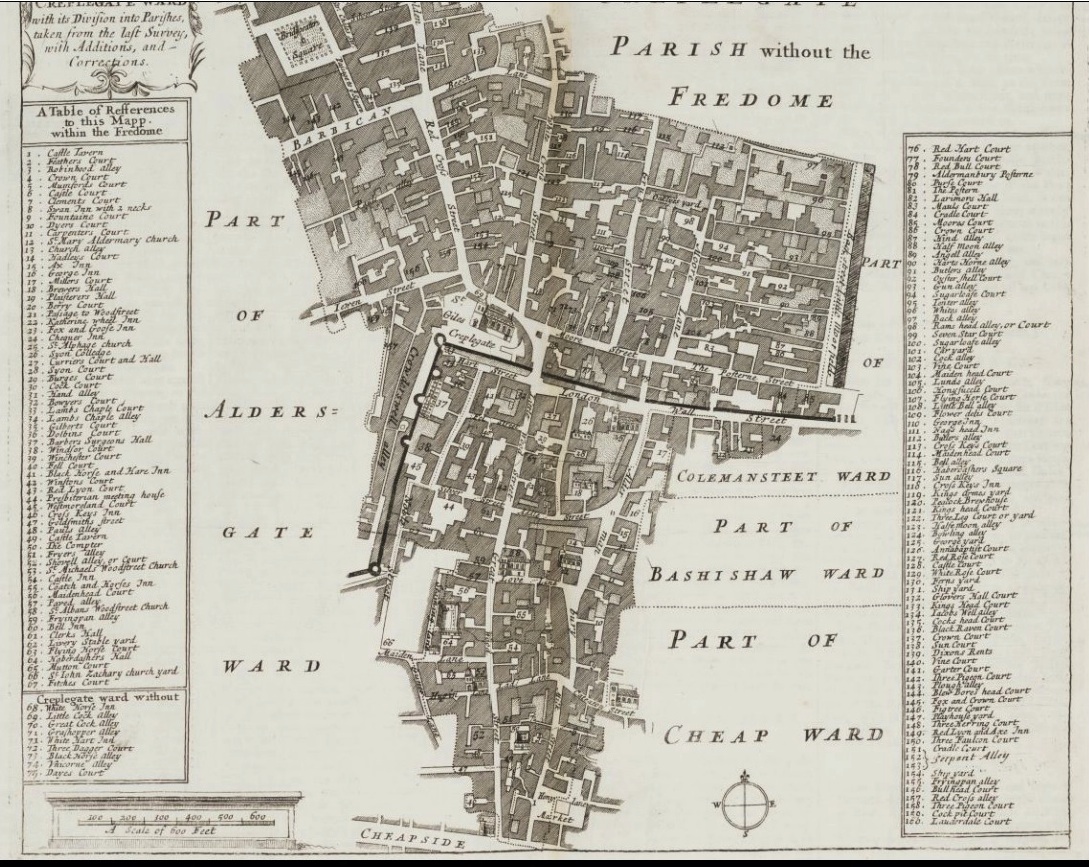
Here’s a view of Cripplegate, or ‘Creplegate Parish’ in Strype’s edition of Stow’s Survey of the cities of London and Westminster (1720, 2 vols), courtesy of The Grub Street Project (click to see a zoom-able image):

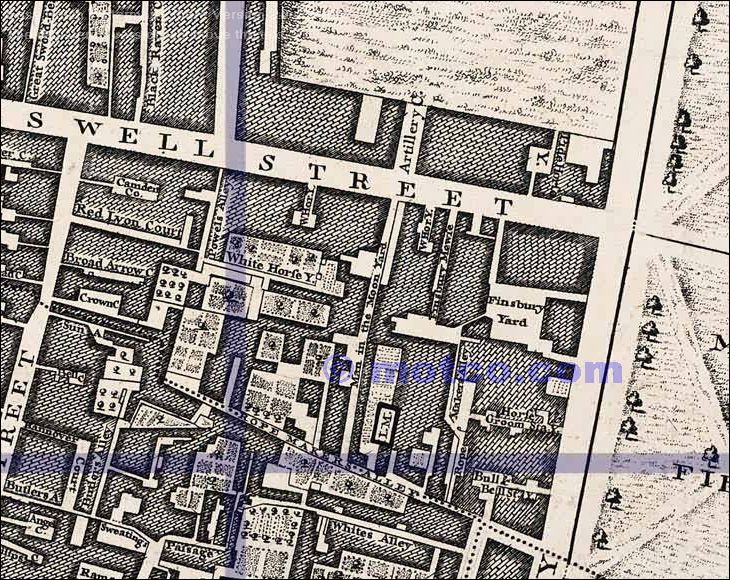
As Rogers argues, Defoe’s honorary membership of the Dunces club owes much to his beginning and ending his life within the purlieu of that home of the Dunces, Grub Street (Grub Street, 311-27). On Strype’s 1720 edition of Stow’s Survey (above), Grub street runs roughly North-South between and parallel to Moore Lane and White Cross Street. According to John R. Moore (Daniel Defoe: Citizen of the Modern World, 3) Defoe’s father ran a business from Fore Street: on the Strype map this began at St. Giles, ran into Moore Street which then became Posterne Street at its eastern end. The minister of St. Giles, Samuel Annesley, was praised in an elegy by Defoe in 1697. In the section of John Rocque’s A New and Accurate Survey of the cities of London and Westminster (1746), below, you can also see Grub Street running North off Fore Street (via Old Bailey Online, images courtesy of Motco Enterprises Limited Ref: www.motco.com):

In the last months of his life Defoe was hiding from creditors, and between August 1730 and April 1731 he took lodgings in Ropemaker’s Alley, in the decidedly mixed environs of Cripplegate. Ropemaker’s Alley was just a few streets East of White Cross Alley where his wife, Mary, had property and Max Novak suggested that this might have enabled Defoe to keep in touch with his family (Daniel Defoe: Master of Fictions, 702). Ropemaker’s Alley cannot be seen in Strype’s Map: it is just North of the City Walls in the area known as the ‘Freedoms’. If you look on the Strype map it would be just above and just outside the far North-West corner of Cripplegate ward. On the next section of Rocque’s 1746 map, below, you can see it fairly clearly as a thin street running North-West from Finsbury, bordering Moorfields (‘a moorish rotten Ground’, Strype, 1.70). South East off Finsbury and below Moorfields was Bethlehem Hospital, or Bedlam. The dotted line represents the boundary chains of the City.

Strype describes Ropemaker’s Alley, in ‘Cripplegate Ward without the Wall’, as ‘pretty broad, with several Garden Houses, which are well built and inhabited’, which sounds rather genteel. Nearby, however, alleys and streets were ‘meanly built and inhabited’ and ‘very mean’ (Strype, 1:92) and the proximity to Grub Street would have confirmed for many Defoe’s association with the profession of hacks. Defoe died on the 24th or the 25th April 1731 and was buried in Bunhill Fields, just North from Chiswell street, and which is now the location of the nineteenth-century memorial to Defoe.

Crowdsourcing the Humanities: Chris Lintott speaks at the Digital Humanities Summer School, Oxford 2012.

While attending the Digital Humanities Summer School at Oxford university this summer, I had the chance to see a variety of lectures. The first of these was by Chris Lintott (Department of Physics, University of Oxford). Chris Lintott has been involved in the development of what has been termed Citizen Science – the communal engagement with science research – and runs one of the most notable of these projects, Zooniverse. My apologies if this is somewhat after the event, but here is the gist of Chris’s talk.

Chris started with the example the data produced by astrophysical research: CERN, for example, produces hundreds of terabytes of data per second during its experiments (Terabyte = c.1000 Gb). This is ‘Big Data’ indeed and pushes at both the limits of computing and the funding of such research. As an answer to the processing and the funding of digging such large amounts of data, crowdsourcing produces a very rich dataset. Involving multiple readers of data, crowdsourcing enables a high level of crosschecking and has been generating original knowledge and insight.

Chris then enumerated a number of examples of science-related projects that use communal collaboration to dig data; the first of which was Galaxy Zoo which analyses data from the Hubble space telescope. Galaxy Zoo makes it easy for non-academics to take part: as you can see on the page that asks for your help classifying types of galaxies, it is as easy as clicking a button. This is a very important feature of getting communal participation: make it too difficult at the first step and you’ve lost your potential researcher. Chris argued that the key to people’s participation in crowdsourcing research like this was motivation: after a motivation survey was conducted that asked what kind of involvement people preferred the largest proportion voted to ‘contribute’. It reflected, he suggested, a powerful desire for people to own their research. Indeed, that first step led on to people producing their own specialised communities (and their own online forums) within the larger Galaxy Zoo community. In most areas of new research there are typically a number of known unknowns, so it was also key to produce task-specific fields of enquiry, managing the kind of questions you want crowdsourced.

The extension of Galaxy Zoo to encompass a number of new areas of large-scale projects resulted in the umbrella project Zooniverse. Chris warned not to ignore the problems of scale and specifically not to underestimate the potential numbers of contributors: across its various projects Zooniverse currently has 666,074 people taking part (Galaxy Zoo on its own has had around 250,000 people involved so far). While the project is dominated by astrophysics (five  projects based on data supplied by space telescopes and satellites) it also includes humanities-orientated projects: transcribing papyrus documents in Ancient Lives, interpreting whale song Whalefm (‘Whalefm’), and analysing historical climate data Old Weather. Old Weather uses the meticulously recorded weather data contained in Royal Navy ships’ logs dating back to the eighteenth century. What’s particularly interesting in this project is that the ships’ logs also include a huge variety of the day-to-day details of shipboard life – anything, in fact, that particular duty officer chose to write down. This data is also included in the project’s database and is fully searchable, so the community is engaging with research well beyond the confines of climatology.

Chris then moved on to discuss a variety of other humanities-focused crowdsourced projects, including the Bodleian library’s project on musical scores What’s the Score. Commenting again on the issue of building motivation, Chris commented that the most successful crowdsourcing projects do not face users with tutorials but use mini-help boxes supplying context as they go long: ‘dump them into the deep end’ he suggested! Indeed, the New York Public library’s project to transcribe thousands of restaurant dishes on its huge collection of historical menus is a good example. Participation in the What’s on the Menu project starts with just the click on one button (they’re up to over a million of dishes). Crucial, then, it to ensure that results are immediately obvious and tangible and that engagement with the wider community is easy. The Ancient Lives project (under the Zooniverse umbrella) involves transcribing ancient papyrus and uses a basic on-screen interface like a transcribing keyboard. It also includes a feature called ‘Talk’ – one click from the interface to engage in immediate responses to a particular image one is working on.

This lead Chris to argue that perhaps ‘crowdsourcing’ may not be the right way of conceptualising the kind of work done by such communal research and suggested that gaming theory might be more applicable to certain projects: an alternative way to imagine the motivation and rewards of crowdsourcing. Examples here include Fold it: a game to research protein molecular structures, which is, it has to be said, complex and expensive. Similar, but much more user-friendly and addictive looking, is DigitalKoot. At first glance this involves two games, ‘Mole Bridge’ and ‘Mole Hunt’, but they are in fact programs designed by the National Library of Finland to transcribe 19th Finnish-language newspapers: as you play you transcribe. Turning analysis into gaming is obviously attractive and involves a shift in motivation. Similarly, the communal engagement with the SETI project (the Search for Extra-terrestrial Intelligence) offers various badges depending on what you have found, from interesting signal to an actual alien. However, this exemplifies the potential problems in gaming and motivation: unsurprisingly no one has yet got the top badge in SETI. In short, Chris argued, don’t replace authentic experience and meaningful participation with goals. Instead, if we wanted to design projects around crowdsourcing, he reminded us that the people who want to get involved in such communal research are specialists in something: build on that.

CMS and VLEs vs … something else

Increasingly, I’ve become frustrated by the VLEs I’ve seen in the various institutions I’ve taught in (‘Virtual Learning Environment’: what in the US is more likely to be called CMS). Regardless of the provider, the VLE belies what its utopian name implies. I remember in the late 1990s doing a workshop at Leeds University on what I later realised was a VLE. I remember the language very clearly: that we would create virtual ‘spaces’ that students would ‘enter’ to work ‘in’. Looking at what is now standard across many HE institutions, it is far from a virtual environment that is truly interactive; the US acronym is much closer to what the software feels like – a ‘Course Management System’. It’s also closer to what students perceive it as. It might well be the digital face of a tutor’s module, but it still feels very much like the institutional face of that teaching; and it feels that way to students and tutors alike. Having an interface that tries to combine ‘hard’ features (institutional information, assessment portals – including plagiarism detection software – grading systems) with the other ‘soft’ features (such as resources and links attuned to the ethos of the tutor and their specific module) creates an odd and unappealing amalgam that does not best enable – from the student – a productive engagement with the module. I have seen wonderful things provided on the VLE pages of some my colleagues’ modules: but even at its best, it can still tend to be a rather one-sided digital conversation.

If we want to create a parallel learning space (and I use the spatial metaphor advisedly) to the space of the lecture or seminar or tutorial – and I think we should – then I’ve come to conclusion that we should move away from, or provide something else other than, the VLE / CMS. I’m perfectly aware that the major providers have been adding a huge variety of platforms to mirror the direction of web 2.0, but mine and my colleagues’ attempts to use the in-built blogs or the wiki packs have not been successful. This is partly to do with the clunkiness of the interface: it’s not intuitive, so students get caught up in the mechanics at the expense of the purpose of the exercise. But it’s also to do with the institutional effect of the VLE. I recently asked my class on eighteenth-century fiction about what kind of digital / online forum they would prefer if they wanted a ‘space’ parallel to the seminar and they overwhelmingly voted for something outside the VLE (they actually voted for Facebook because it was something most were familiar with). Recently, Carrie Shanafelt posted an adroit series of observations on using wikis in the classroom and, in particular, the negative effects of compulsion which I think my own observation on the institutional effect of the VLE / CMS parallels.

My thoughts have been also catalysed by an ongoing experiment to develop (with the help of Gavin Wilshen – thanks!) a blog-site for an MA programme. The potential opportunities for a properly interactive interface between students and tutor are underlined by the ability for tutors and students to post a continuous series of news and commentary and links to create an ongoing conversation around the topics of the course that is parallel to – and to an important extent – outside the space of the institutional face of the VLE.

I certainly thinking that some form of free blogging software is the way forward. So, right now I’m considering what particular platform might best enable a more intuitive way for my undergraduate students to interact with the materials and the topics of my modules in an online space outside or parallel to the classroom, but perhaps also outside the VLE. TBC …